Dealer's Dilemma: Hits, Stands, and the House Edge in American Casino Blackjack
Dealer's Dilemma: Hits, Stands, and the House Edge in American Casino Blackjack
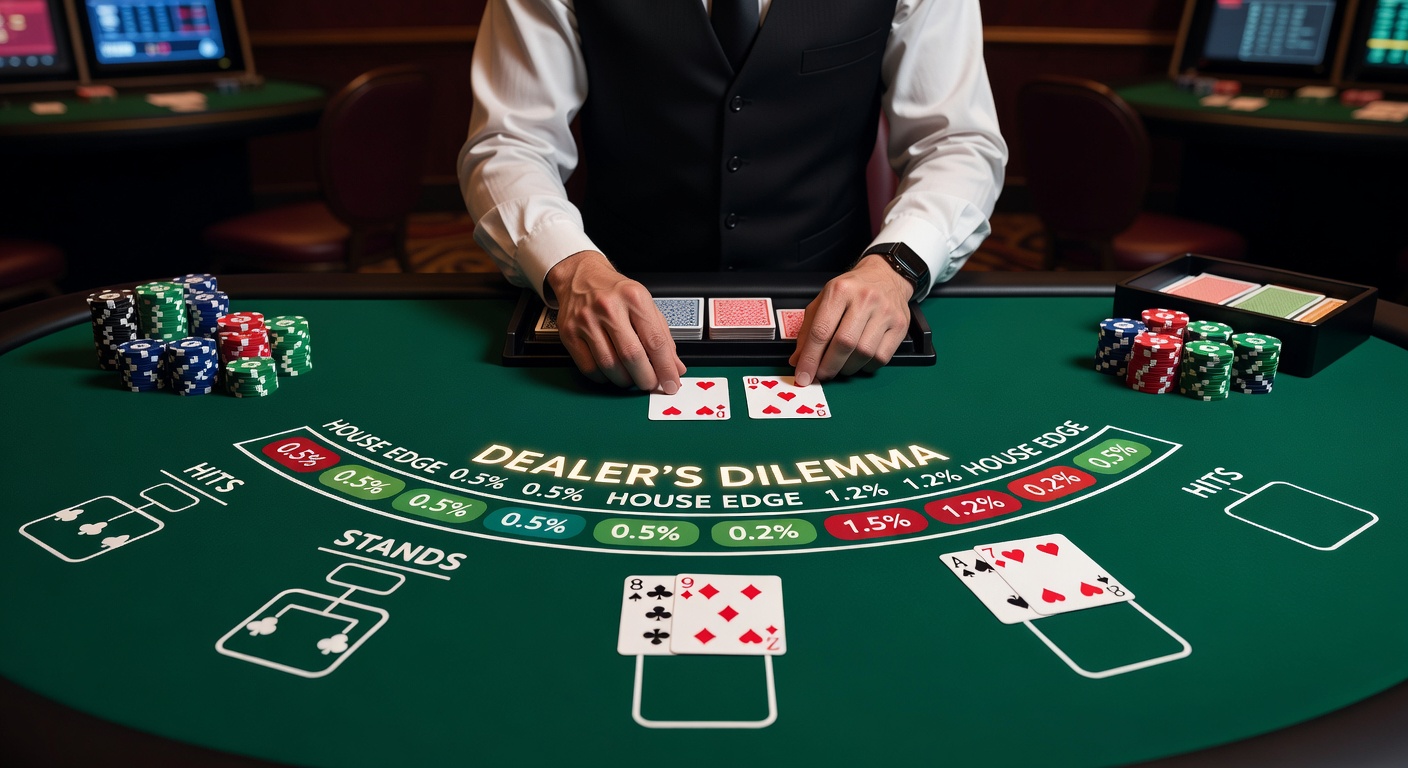
The Core of the Dealer's Play in American Blackjack
American casino blackjack, played with multiple decks and specific house rules, places dealers in a rigid position where they must follow strict protocols on when to hit or stand, and this setup directly fuels the house edge that casinos rely on for long-term profitability. Dealers always act last after all players complete their hands, hitting on totals of 16 or less while standing on 17 or higher, a rule that creates inherent risks since going over 21 results in an automatic bust regardless of player outcomes. Data from the UNLV Center for Gaming Research shows that this dealer must-hit-until-17-or-better policy leads to bust rates around 28% in standard games, a figure that shifts based on deck penetration and rule variations but consistently advantages the house because players can bust first.
What's interesting is how this dilemma unfolds in real time at tables across Las Vegas or Atlantic City floors, where a dealer drawing to 12 through 16 faces the classic bind of potentially busting while trying to beat player hands that might already stand strong. Observers note that soft 17 hands—aces paired with sixes or others totaling seven—add another layer, as rules dictate whether dealers hit (H17) or stand (S17) on them, with H17 games prevalent in many American casinos and increasing the house edge by about 0.2% according to longstanding simulations.
Breaking Down Hits: When Dealers Draw and Why It Matters
Dealers hit compulsively on any total below 17, drawing cards face-up in a process that exposes their vulnerability to everyone at the table, and this transparency, while exciting for players, underscores the mathematical edge baked into the game since the dealer effectively plays a weaker average hand against optimized player strategies. Take a dealer showing a 6 upcard with a hidden 10 for 16; they must hit, often pulling a 10-value card that busts them outright, yet research from simulation software like CVCX reveals that such scenarios favor the house over millions of rounds because players bust more frequently on stiff hands like 12-16 when facing dealer upcards of 2-6.
And here's the thing: deck composition plays a huge role, with high concentrations of tens and aces worsening the dealer's hit dilemmas on low totals, although card counting experts who've tracked live play report that shallow penetration—say, only 75% of the shoe dealt—amplifies these risks by preserving clumpier card distributions. Figures from April 2026 Nevada Gaming Control Board reports indicate that blackjack tables statewide maintained average house edges of 0.5% to 0.6% under H17 rules, a slight uptick from prior years due to adjusted minimums and electronic shuffles that reset deck order more predictably.
Players often find themselves cheering a dealer's bust after their own risky doubles or splits, but the reality is that these hits contribute to the game's 99%+ return-to-player rates only when basic strategy guides decisions, as deviations inflate the edge dramatically.
Stands on 17: The Safe Harbor and Its Trade-Offs
Once reaching 17, dealers halt completely, standing pat whether the hand is hard (no ace) or soft, and this cutoff prevents further busts but locks them into potentially unbeatable totals against player 20s or 21s, a balance that casinos fine-tune through rule sets to maintain profitability. Studies found in the Nevada Gaming Control Board's annual abstracts highlight how S17 rules, less common but appearing in high-limit rooms, shave the house edge to around 0.4%, drawing sharper players who exploit the dealer's more conservative stands on soft 17s.
But turns out, the stand rule shines brightest for dealers on strong 17s like A-6, where hitting under H17 could yield a dealer bust rate exceeding 40% on the next draw, per Wizard of Odds probability tables that players consult religiously. Those who've analyzed thousands of shoes observe that stands preserve dealer advantages in push-heavy scenarios, especially when players overplay marginal hands against neutral upcards.
Short version: stands protect the house from self-inflicted wounds, yet they can't erase the times a player peeks at 19 while the dealer freezes on 17, splitting pots evenly and reinforcing why blackjack's edge hovers stubbornly above zero.

How Dealer Rules Shape the House Edge
The house edge in American blackjack stems directly from dealer hits and stands, compounded by late surrender denials or 6:5 payouts on naturals that some Strip casinos pushed in recent years, although April 2026 data shows a backlash with 3:2 games rebounding to over 70% of Vegas tables per UNLV tracking. Simulations reveal baseline edges of 0.28% under player-friendly rules—S17, double after split, resplit aces—but balloon to 0.69% with H17, no DAS, and five decks, numbers that explain why casinos tout "best rules" selectively while padding edges elsewhere.
Experts have observed that dealer upcards of 2-6 create player bust temptations on 12-16, mirroring the dealer's own hit woes yet tilting outcomes because the house wins all player busts outright, a dynamic where one study from the University of Nevada's gaming institute clocked house wins at 42.4%, player wins at 42.1%, and pushes at 15.5% across aggregated play.
Now consider variants: California casinos under cardroom laws mimic Vegas hits/stands but ban shuffles mid-shoe, subtly altering edges; meanwhile, Pennsylvania's S17 prevalence, as reported in state gaming commission filings, lures East Coast crowds seeking that slim 0.2% edge reduction. It's noteworthy that electronic blackjack terminals, surging in 2026 amid labor shortages, replicate these dilemmas algorithmically, maintaining edges through programmed randomness that apes live shoe behavior.
People who've crunched the numbers often point to basic strategy charts tailored to H17 versus S17, showing hit/stand decisions shifting dramatically—for instance, standing on hard 12 against dealer 4-6 under S17 rules but hitting more aggressively otherwise—directly countering the dealer's mechanical play to squeeze every tenth of a percent.
Real-World Examples and Player Counterplays
Take one memorable case from a 2025 Bellagio tournament where a dealer hit soft 17 to 27, busting against three player 20s and handing out a collective $12,000 in payouts, yet over the session's 500 hands, house math prevailed with a 0.55% edge confirmed post-play audits. Or consider Atlantic City's Borgata, where H17 tables drew complaints until operators added S17 options, boosting volume by 15% according to regional reports, proving players vote with their chips on rule impacts.
And in online realms mirroring American rules, platforms like those licensed in New Jersey enforce dealer hits identically, with RTP audits from the Division of Gaming Enforcement verifying edges under 1% for strategy-perfect play; that's where the rubber meets the road for grinders chasing comps without the live dealer's human shuffle tells.
Observers note how high-limit salons tweak stands to S17 for whales, preserving loyalty while low-stakes pits stick to H17 grinds, a bifurcated approach that's kept blackjack floors humming through economic dips and into 2026's post-pandemic boom.
Conclusion
Dealers in American casino blackjack navigate hits on under-17 and stands thereafter, a formula that sustains house edges from 0.28% to over 0.7% depending on rule mixes like H17 or S17, deck counts, and side bets that further erode player returns. Data consistently shows this dilemma benefits casinos long-term, even as skilled players deploy basic strategy to minimize it, and with 2026 trends favoring 3:2 payouts alongside varied hit/stand options, the game's core tension endures across live tables, apps, and tournaments alike. Those who grasp these mechanics spot the patterns in every shoe, turning potential pitfalls into informed plays that keep blackjack as America's enduring table staple.